
 Skip to content


When you think of cowboy artwork, you might picture wide-brimmed hats, horses galloping across dusty plains, and sun-baked landscapes stretching to the horizon. But Western cowboy art is far more than visual nostalgia - it's an entire artistic movement that captures the mythology of the American frontier, celebrates independence, and tells stories about a way of life that continues to fascinate us.
From Frederic Remington's dramatic bronzes to contemporary cowboy-inspired prints, this genre has endured for over a century. And right now, cowboy culture is having a major moment. Beyoncé's Cowboy Carter album, the "Cowboycore" fashion trend, and even Vogue declaring 2024 "the year of the cowboy" prove that Western aesthetics aren't going anywhere.
So what makes cowboy artwork so compelling? Why does this art form continue to resonate across generations? Here are five reasons cowboy art deserves a place in your home - and how to style it without turning your space into a theme park.
.png)
Cowboy Art Captures American Mythology (Not Just History)
Cowboy artwork doesn't just depict the Old West - it romanticizes it. And that's exactly the point.
The golden age of the American cowboy lasted roughly from the 1860s to 1890s, a relatively brief period. But in that time, cowboys became larger-than-life figures representing freedom, self-reliance, and the untamed frontier. Artists like Frederic Remington and Charles M. Russell elevated cowboys from working ranch hands to cultural icons, creating paintings that emphasized drama, heroism, and adventure.
What makes cowboy art different from Western historical documentation:
-
It emphasizes the feeling of the West - wide-open spaces, independence, danger
-
It focuses on pivotal moments: cattle drives, standoffs, sunset rides
-
It mythologizes cowboy life, often omitting the mundane or difficult realities
-
It creates archetypes: the lone rider, the rugged individualist, the fearless woman of the West
Contemporary cowboy artwork continues this tradition. Modern pieces like Alejandro and El Roi capture that same spirit - the gaze of someone who's lived on their own terms, unbound by convention.
Why this matters for your home: Cowboy art isn't about literal cowboys. It's about what they represent - freedom, adventure, authenticity. When you hang a cowboy-inspired piece, you're bringing that energy into your space.
SHOP THIS LOOK:
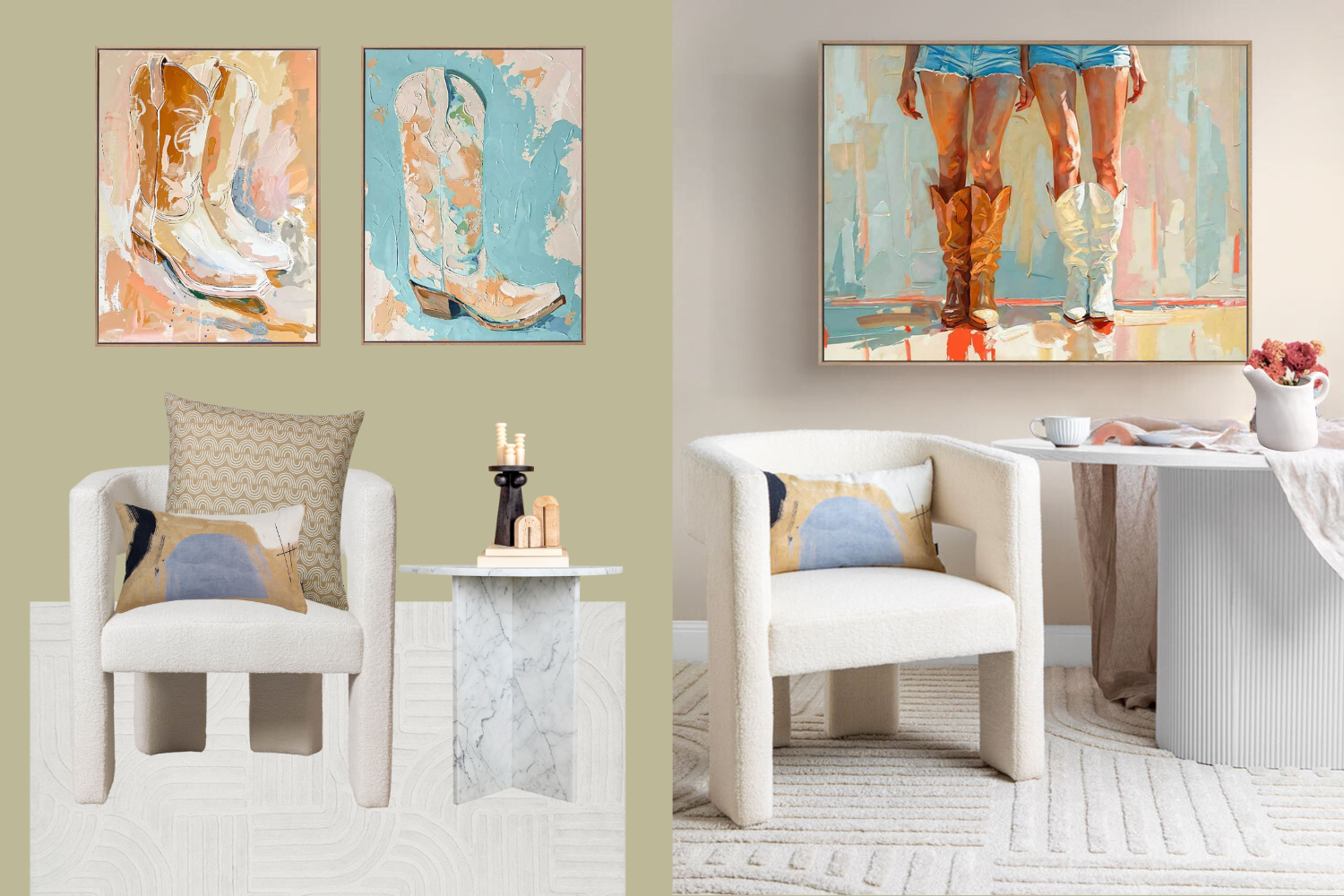
The Symbolism in Cowboy Art Tells Deeper Stories
Every element in cowboy artwork carries meaning. These aren't random pretty pictures - they're visual narratives packed with symbolism that Western audiences instinctively understand.
Classic cowboy art symbols and what they mean:
The Horse - More than transportation, horses represent partnership, freedom, and survival. In cowboy art, the relationship between rider and horse is sacred - a bond built on mutual trust in dangerous territory.
The Hat - A cowboy hat isn't just practical; it's identity. The way it's worn, its condition, its style - all tell you something about the person wearing it. In art, a tilted hat suggests confidence; a weathered one indicates experience.
The Landscape - Those endless skies and wide-open plains aren't just backdrop. They represent possibility, isolation, and the smallness of humanity against nature's vastness. The landscape in cowboy art is often as important as the figure within it.
The Sunset/Sunrise - These aren't just pretty. Sunsets in Western art symbolize endings, reflection, and the day's hard work done. Sunrises represent new beginnings, hope, another day survived.
Boots and Spurs - Tools of the trade, but also status symbols. Well-worn boots tell of miles traveled; decorative spurs suggest pride in the craft.
Contemporary pieces play with these same symbols. Sunset Stroll captures that iconic golden-hour moment, while Pastel Rodeo gives traditional rodeo imagery a softer, more contemporary treatment.
Why this matters for your home: Cowboy art works because it communicates without words. A single image can evoke adventure, nostalgia, independence - all through visual shorthand we've been culturally trained to understand.
SHOP THIS LOOK:
.png)
Vintage Cowboy Aesthetics Bring Warmth to Modern Spaces
There's something inherently comforting about vintage cowboy art. The sepia tones, the slightly grainy quality, the nostalgic subject matter - it all creates a sense of timelessness that softens contemporary interiors.
Why vintage-style cowboy art works in modern homes:
It adds warmth to minimalism - Modern spaces can feel cold or sterile. Vintage cowboy art introduces human warmth, texture, and story without cluttering the visual field.
It provides contrast - The rough, weathered quality of Western imagery creates compelling contrast against sleek furniture and clean lines. This tension makes both elements more interesting.
It evokes emotion - Vintage cowboy art taps into collective nostalgia - not necessarily for a time we lived, but for an idealized past we recognize from stories, films, and cultural memory.
It works with neutral palettes - Those dusty browns, faded blues, and sun-bleached tones naturally complement contemporary neutral color schemes.
Contemporary pieces like Untamed Cowboy and Outback Escapades capture that vintage feel while being produced as modern prints - giving you the aesthetic without the fragility or cost of actual antique artwork.
Styling tip: Pair vintage-style cowboy art with natural materials - jute rugs, travertine tables, sherpa textiles. This creates cohesion between the organic, handmade quality suggested by the art and the physical textures in your space.
SHOP THIS LOOK:
.png)
Cowboy Art Has Serious Artistic Heritage
When we talk about cowboy artwork, we're not just talking about decorative prints - we're talking about an established American art movement with significant cultural and artistic importance.
The founding artists who defined the genre:
Frederic Remington (1861-1909) revolutionized how Americans saw the West. His paintings and bronzes captured dramatic action - bronco riders mid-buck, cavalry charges, Native American warriors. His work appeared in major publications, bringing Western imagery into American homes and establishing visual tropes that persist today.
Charles M. Russell (1864-1926) actually lived as a cowboy for over a decade before becoming a full-time artist. His work is considered more authentic than Remington's because he painted from lived experience. Russell captured both the romance and the reality of Western life - the beauty and the hardship.
Georgia O'Keeffe (1887-1986) brought a different perspective to Western art. Her desert landscapes and animal skulls presented the Southwest as stark, mysterious, and spiritual rather than action-packed. She proved cowboy art didn't have to be literal to capture Western essence.
These artists established cowboy art as legitimate American art, not just illustration or decoration. Museums collect their work. Auction houses sell their pieces for hundreds of thousands of dollars. They created visual language that contemporary artists still reference.
Modern cowboy-inspired art like Morning's First Light and Countryman's Best Friend stand on the shoulders of this artistic tradition, translating classic Western themes for contemporary spaces.
Why this matters for your home: When you display cowboy art, you're not following a passing trend - you're connecting with an artistic tradition that's over a century old and shows no signs of fading.
SHOP THIS LOOK:
.png)
Cowboy Art Is Having a Major Cultural Resurgence
Cowboy culture isn't stuck in the past - it's actively shaping contemporary culture right now.
Recent cowboy cultural moments:
Music: Beyoncé's Cowboy Carter (2024) recontextualized country music and cowboy imagery through a Black woman's lens, reminding audiences that cowboys were diverse - roughly 25% of Old West cowboys were Black. The album topped charts globally, proving cowboy themes resonate far beyond traditional country music audiences.
Fashion: "Cowboycore" and "Western wear" have dominated runways and street style. Fringe, leather, cowboy boots, and Western-inspired jewelry aren't costume - they're fashion. Vogue, Elle, and major fashion houses have all embraced Western aesthetics.
Film & TV: Shows like Yellowstone, 1883, and Outer Range have brought cowboy culture back to mainstream television with record viewership. These aren't your grandfather's Westerns - they're complex, morally ambiguous, and visually stunning.
Interior Design: Western and Southwestern design elements - warm earth tones, natural materials, handcrafted textiles - are everywhere in contemporary interiors. The cowboy aesthetic has evolved from "rustic cabin" to "modern ranch," appealing to minimalists and maximalists alike.
This cultural moment means cowboy artwork feels current, not dated. Pieces like Annie's Dusty Ride and Country Grit tap into this resurgence, offering contemporary takes on classic Western imagery.
Why this matters for your home: Cowboy art isn't a nostalgia trip - it's part of an active, evolving cultural conversation. Displaying it puts you in dialogue with contemporary art, music, and fashion movements.
SHOP THIS LOOK:
.png)
How to Style Cowboy Art Without Going Full Saloon
The biggest challenge with cowboy artwork is avoiding the theme-park effect. Here's how to incorporate Western pieces into contemporary spaces authentically:
Do:
-
Pair with modern furniture - Let cowboy art be the rustic element against clean-lined contemporary pieces
-
Use natural materials - Travertine, jute, wood, and leather echo Western aesthetics without being literal
-
Stick to earth tones - Rust, caramel, cream, and warm greys complement cowboy imagery
-
Mix in feminine elements - Boucle textures, soft curves, and blush tones prevent "too masculine" vibes
- Choose quality over quantity - One great cowboy piece > five mediocre ones
Don't:
-
Add cowboy kitsch - No horseshoes, wagon wheels, or "Wanted" posters
-
Go all-in on Western - Cowboy art + Western furniture + wagon wheel chandelier = theme restaurant
-
Ignore the rest of your style - Cowboy art should complement your existing aesthetic, not fight it
-
Forget about scale - Oversized cowboy portraits work; tiny ones feel like memorabilia
Style formulas that work:
Modern Minimalist + Cowboy Art
-
White or neutral walls
-
One large-scale cowboy portrait or landscape
-
Natural wood or travertine furniture
-
Minimal accessories in rust or caramel
Bohemian + Western
-
Layered textiles (jute, linen, leather)
-
Multiple smaller cowboy prints in a gallery wall
-
Warm, earthy color palette
-
Plants and natural elements
Contemporary Luxury + Cowboy Art
-
Statement cowboy portrait as focal point
-
Velvet or boucle upholstery in warm tones
-
Brass or bronze accents
-
High-quality materials throughout
VERSATILE COWBOY ART PIECES:
.png)
Why Cowboy Art Endures
Cowboy artwork has lasted over a century for a reason. It taps into something fundamental - our fascination with freedom, adventure, and lives lived on the edge of civilization. These aren't just pretty pictures of horses. They're visual stories about independence, resilience, and the eternal human desire to explore unknown territory.
Whether you're drawn to vintage-style portraits, contemporary cowboy-inspired prints, or dramatic Western landscapes, this art form offers something deeper than decoration. It brings mythology, history, and cultural significance into your home.
The cowboy may be an American icon, but the values they represent - authenticity, self-reliance, connection to land - are universal. That's why cowboy art continues to resonate across cultures, generations, and design styles.
.png)
Ready to bring cowboy spirit into your home?
MINIMALIST COWBOY STYLE:
CONTEMPORARY WESTERN:


